

Titanic Original Blueprints Go Public for the First Time in Over a Century
For more than a century, the Titanic lived in stories, photos, and fragments of history. Now, something far more detailed has surfaced. The original shipyard blueprints. These are the real working plans used to build the most famous ship in the world.
The release began in late March 2026, and it has opened a door that was long shut. People can now explore the exact lines, measurements, and design choices that shaped the Titanic. This is the first time the general public can access these documents without special permission or academic ties.
A Rare Look Inside a Giant Shipyard Operation
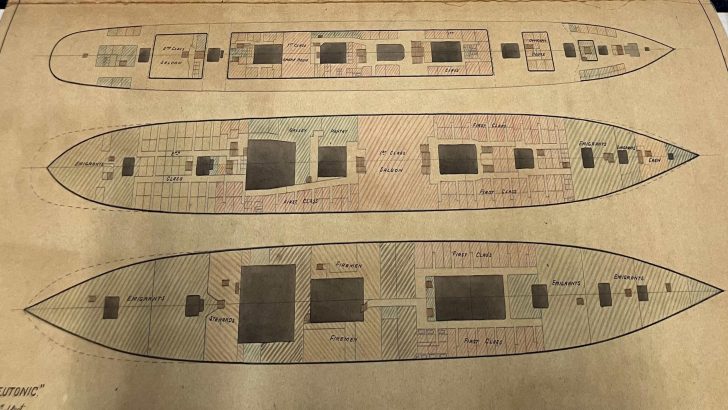
BBC Archive / These blueprints come from the Harland and Wolff archive, a massive collection tied to the Belfast shipyard where the Titanic was built.
For decades, this archive stayed mostly out of reach. Only researchers and experts had the chance to study its contents closely.
Now, National Museums Northern Ireland has made the collection widely available. Anyone can browse the documents online or visit in person. This shift changes how people connect with history. It turns a closed archive into something living and open.
The archive itself is far more than just Titanic plans. It holds hundreds of thousands of documents that show how ships were designed and built during a time of rapid industrial growth. These records capture daily work, technical challenges, and the scale of the operation.
Alongside technical drawings, visitors can find handwritten notes, internal messages, and even a marriage proposal. These details remind us that real people stood behind every line drawn on those pages.
The Design Marvel
The Titanic was a groundbreaking and gigantic masterpiece of the time. When it launched, it was the biggest and most advanced ship ever built. The blueprints show exactly how engineers achieved that level of scale and complexity.
Every part of the ship was carefully planned, from the grand staircases to the engine systems deep below deck. The drawings reveal how space was used, how weight was balanced, and how luxury and function were combined.
One of the most talked-about features was the watertight compartment system. Many believed this design made the ship nearly impossible to sink. The blueprints now allow people to study that system in detail and understand its limits.
The Core Objective of the Release

Ships of the Seas / IG / This release is part of a larger project called “From Drawing Board to Slipway.” The goal is to organize and share Belfast’s shipbuilding history with the world.
The project is backed by funding from the Archives Revealed programme.
Archivist Siobhan McLaughlin has described the effort as a way to unlock hidden stories. That idea goes beyond the Titanic itself. It brings attention to the workers, designers, and everyday lives tied to the shipyard.
Harland and Wolff was purchased by Navantia UK in 2025, which has renewed interest in the site’s legacy. Making the archive public adds to that momentum and gives the shipyard a new kind of relevance.
For many people, the Titanic has always felt distant, almost like a legend. These blueprints change that feeling. They bring the ship back into focus as a real object, built step by step by skilled hands.
More than 1,500 people lost their lives when the Titanic sank in April 1912. That fact has never changed, but the way we understand the ship continues to evolve. These documents add depth to a story that many thought they already knew.
The wreck was found in 1985 by Dr. Robert Ballard and his team, which gave the world its first clear look at the ship’s remains. Now, decades later, the blueprints offer a view from the beginning rather than the end.
More in Cutting Edge
More From HealthyGeorge
-

-
 How Mindfulness Boosts Memory and Future Planning Skills
A small shift in daily habits can influence how well the brain keeps track of future plans. Recent findings suggest that...
Life HacksApril 30, 2026 -
 Inside the Bel-Air Jewel Heist That Rocked Kathy Hilton and “RHOBH” CastCulture & FunApril 25, 2026
 -
 Gen Z’s Viral “Rawdogging Boredom” Trend May Help Fix Their Attention Span
A strange trend is taking over TikTok. Gen Z creators are filming themselves sitting in silence, doing absolutely nothing for minutes...
Life HacksApril 3, 2026 -
 These Cutting-Edge Depression Treatments Are Finally Addressing Women’s Mental Health CrisisCutting EdgeMarch 28, 2026
You must be logged in to post a comment Login